Can any house be moved? Timber and Queenslander-style homes are often excellent candidates, but they are not the only homes that can be relocated. What matters is how the building is constructed, its condition and size, and whether it can be safely separated, transported and re-established at the new site.
Get a free quote → or call 07 3888 9399.
Queenslanders, workers’ cottages and other timber-framed homes make up a large part of the house relocation work Mackay & Sons does.
These homes are often well suited to relocation, particularly when they are constructed on stumps or a raised subfloor.
However, age or construction type alone does not determine whether a house can be moved. We also consider:
Each house still needs to be assessed individually before its suitability for relocation can be confirmed.
Brick homes can sometimes be relocated, but the way the home has been constructed is very important.
A timber-framed, stumped home with a brick veneer or brick facade may be suitable for relocation. In these cases, the brickwork generally cannot travel with the house and would need to be removed as part of preparing the home for transport.
A double-brick or full masonry home, however, is generally not suitable for conventional house relocation because the masonry forms a structural part of the building.
This is why a house being described as “brick” does not necessarily tell us whether it can be moved. We need to understand what is behind the brickwork and how the house is supported.
Slab-on-ground homes are generally not considered suitable for house relocation.
Unlike a stumped or raised home, the house and flooring are constructed directly on the concrete slab. The slab itself cannot simply be picked up and transported with the building, which means relocating the structure can involve significantly more work and cost, while also leaving the home without its existing flooring system.
Although there may be unusual circumstances where parts of a slab-on-ground building could technically be relocated, the additional work and expense generally make it impractical compared with relocating a home that has been built on stumps.
For this reason, Mackay & Sons generally focuses on homes constructed on stumps or another suitable raised foundation system.
Yes, but the overall size of the house is only one part of the equation.
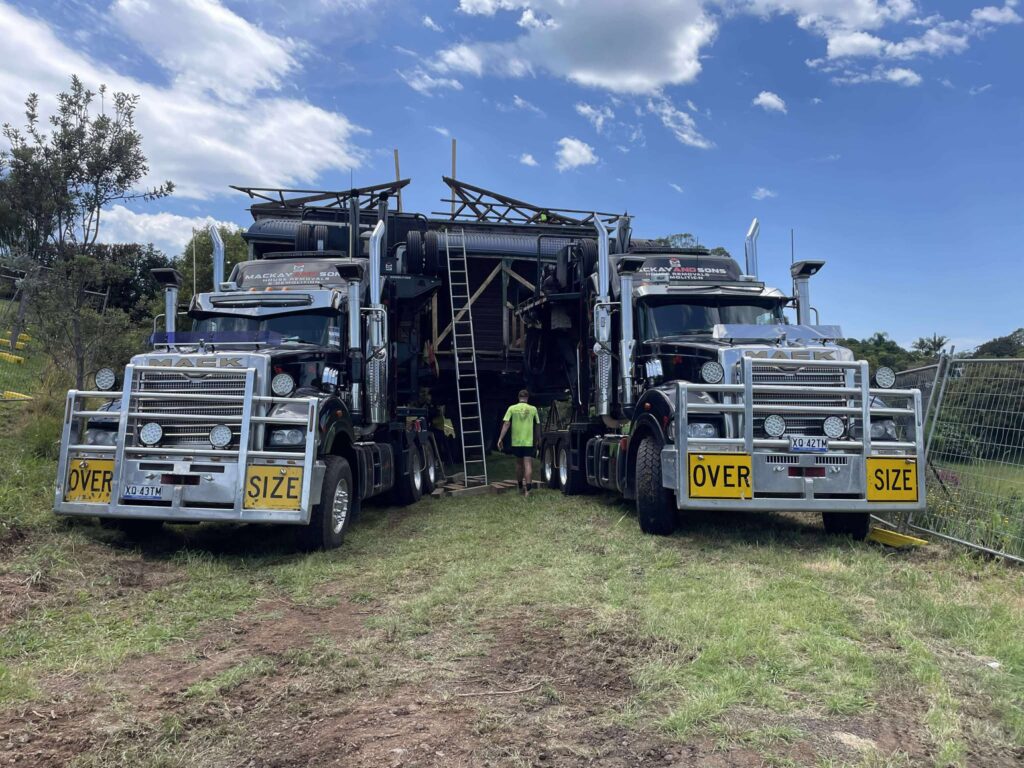
Large and wide homes can often still be relocated by separating them into multiple sections before transport and reconnecting those sections at the destination.
The number and size of those sections can depend on:
A house may physically be able to move in one section, but the transport route can ultimately determine how wide each section is allowed to be.
Roof shape, verandahs, extensions and alterations made over the years can also affect how the house needs to be prepared for transport.
You don’t need to work it out yourself!
Send us some photos and basic information about the house, including its location, construction and where you would like it moved.
We can provide an initial indication of whether the home looks suitable for relocation. If the project needs a closer look, we can then arrange the appropriate site assessment before confirming the relocation scope.
Looking for a house instead of moving your existing one? Browse our current removal houses for sale.
If a house cannot be moved, demolition may be the next option. See our house demolition cost guide.
Get a free quote → or call 07 3888 9399.
Want to understand the whole process? Read about house removals in Brisbane, find out what affects the cost or see how long a relocation can take.
Brisbane City Council’s page on relocating a house explains what approvals a moved house needs.
Mackay & Sons specialises in timber and Queenslander-style homes, including cottages and character houses. Suitability still depends on the structure, condition, size, access and proposed transport route.
There isn't a simple list of houses that can never be moved. Brick, masonry and slab-on-ground homes are generally much more difficult to relocate and are often not practical candidates, but each building needs to be assessed on its own structure and condition.
There isn't one useful size limit that applies to every job. Wider or larger homes may need to be separated into sections for transport, and the final approach depends on the house, route, access and permit requirements.
Send us the property details and photos and we'll assess the house. If more information is needed, we can arrange a site assessment before confirming whether relocation is practical.